Advancing Women Entrepreneurs in South Africa’s Renewable Energy Value Chain
Background and context
South Africa’s fast-growing renewable energy sector is reshaping the electricity landscape and creating new opportunities for employment, enterprise development, and local economic growth. However, meaningful inclusion remains a persistent challenge. Women continue to be under-represented, particularly in technical, leadership, and ownership roles that shape decision-making and influence the direction of the sector.
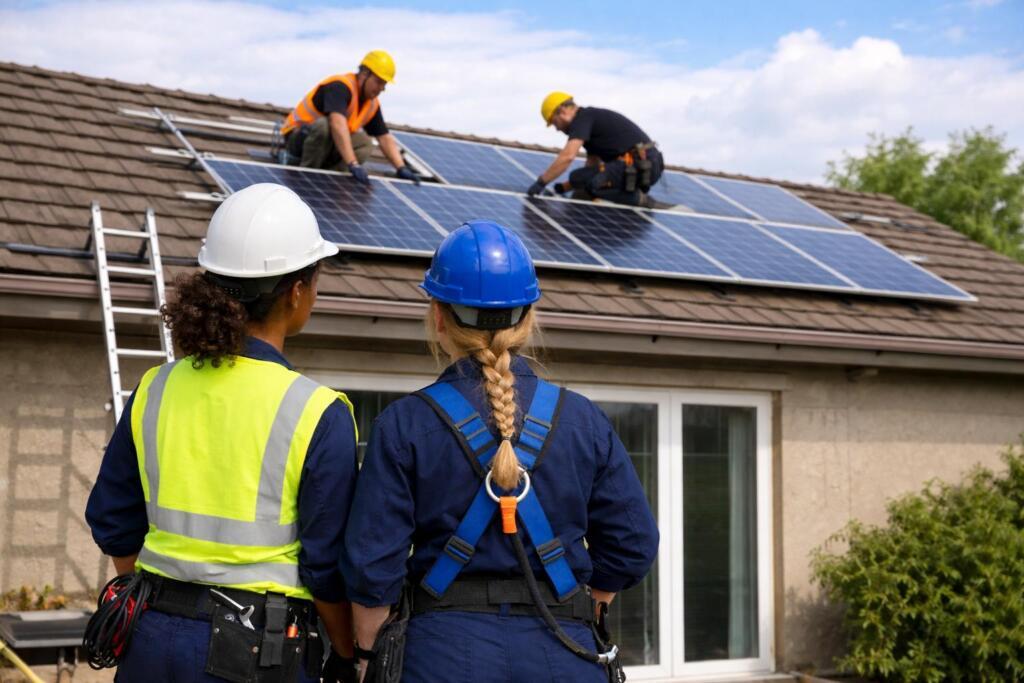
Decentralised renewable energy (DRE) technologies, such as rooftop solar PV and battery storage, offer a promising pathway to address these gaps. By bringing energy production and services closer to communities, DRE creates opportunities across installation, system design, operations and maintenance, and customer services. Evidence from across Africa shows that women-led DRE enterprises can generate income, strengthen household and community resilience, and support more inclusive development outcomes. Despite this potential, women-owned and women-led small, micro and medium enterprises (SMMEs) in South Africa continue to face structural, social, and skills-related barriers that limit their effective participation in the renewable energy value chain.
Objectives of the study
GIZ commissioned CPCS, together with Nova Economics and Just Green Strategies, to undertake a scoping study to identify where women entrepreneurs can enter and compete in South Africa’s renewable energy sector, and what support, knowledge, and tools are required to enable their participation. The study focused on the decentralised renewable energy value chain, with particular emphasis on solar PV and battery storage systems. It sought to understand the barriers and enablers shaping women’s participation and to identify practical pathways to support women entrepreneurs, drawing on market analysis and real-world case studies.
Our approach
The study adopted a mixed-methods approach. Key activities included a review of global and South African literature on women’s participation in renewable energy, mapping of the DRE value chain, stakeholder interviews, and barrier analysis informed by both quantitative data (such as gender-disaggregated labour force statistics and education pipeline data) and qualitative insights. A multi-stakeholder workshop was held towards the end of the engagement to share the study’s findings and obtain feedback from women working in the sector, ensuring that the analysis and recommendations reflected on-the-ground realities.
Key findings/outcomes
The DRE value chain offers significant entry points for women and SMMEs
The analysis divided South Africa’s decentralised solar PV market into small-scale systems for homes and small businesses (under 30 kWp) and larger commercial, industrial, and agricultural systems (above 30 kWp). The small-scale segment is found to be more labour-intensive and dominated by local installers, creating relatively accessible entry points for SMMEs, especially in installation, system design, and operations and maintenance. By contrast, most value in the large-scale C&I market lies in project development, engineering, and financing, which are controlled by a few well-capitalised firms, making entry more difficult for women-led businesses without targeted support.
While women are more visible in renewables than in other energy sub-sectors, they are still concentrated in non-technical and support roles, with technical and decision-making positions remaining largely male-dominated.
Women face a multi-level set of barriers
Six interrelated categories of barriers were identified to constrain women’s participation:
- Societal and cultural norms reinforce perceptions that energy and technical roles are “male domains,” limiting women’s confidence and ambition.
- Educational pipeline weaknesses reduce the number of women entering STEM fields and holding the relevant qualifications and training required to fulfil technical and leadership roles.
- Workplace and hiring barriers, including site-based work, inflexible hours, limited mentorship and access to networks, and male-dominated professional cultures, slow women’s career progression.
- Policy fragmentation, limited implementation and superficial compliance reduce accountability for gender-transformative outcomes despite a strong national framework.
- Entrepreneurship constraints, especially limited access to finance, networks, and market opportunities, impede the growth of women-owned SMMEs.
- Self-perception and confidence gaps, reinforced by a lack of female role models, deter women from applying for technical roles or starting businesses.
Recommendations
The study proposed a set of interventions across four strategic pillars.
- Align and strengthen the Women Empowerment and Gender Equality (WEGE) strategy for DRE by updating the WEGE framework and re-establishing an advisory council with clear mandates to drive accountability across the energy transition.
- Create funded education to employment pathways for women into DRE careers through bursaries, mentorship, work placements, and industry exposure, supported by strong and visible female role models.
- Transform workplace practices by incentivising gender-inclusive practices in DRE firms through gender reporting, B-BBEE-linked accountability, and skills-based hiring and training that enables women to move into technical and leadership roles.
- Support women’s entrepreneurship via a dedicated Women in Renewable Energy (WiRE) enterprise track within existing incubators to provide integrated support on finance, skills, regulation, market access, and mentorship for women-led DRE businesses.

Client
The Deutsche Gesellschaft für Internationale Zusammenarbeit (GIZ) GmbH
Date Completed
2025
Author(s)
- Kay Walsh
- Tessa Hubble
- Kgaogelo Makoe
- Leina Benouniche
- Aradhna Pandarum
Related Work
Related Links